

Direct Answer: A licensed plumber locates it first using meter isolation, a hot-side test, acoustic listening gear and thermal imaging, then opens only a small area. Maverick Plumbing Technicians, Inc. handles slab leaks in Santa Cruz.
You are standing on the floor you are worried about. Maybe one spot in the hallway feels warm, maybe the water bill jumped for no reason, and the thing stopping you from calling is a picture in your head of a jackhammer and a pile of broken concrete in your living room. If you think you have a slab leak under your house in Santa Cruz, Maverick Plumbing Technicians, Inc. is a licensed plumbing contractor here in town that locates and repairs slab leaks across Santa Cruz County and parts of Monterey County.
Here is the part most homeowners do not know: locating comes before any concrete gets opened. A proper evaluation narrows the leak down to a small area before anyone picks up a tool, and in plenty of homes the finished floor never comes up at all.
I want to walk you through the order of operations we actually follow, what decides the repair after the leak is found, and the handful of useful things you can do this week while you decide.
“I think I have a slab leak under my house in Santa Cruz. Who can find and fix it?”
Our team does both halves of that job: finding the leak and repairing it, under one license (CSLB #1102966), for homes in Santa Cruz, Live Oak, Capitola, Watsonville and south into Monterey County.
What the work covers:
- Leak detection on hidden lines in walls, under floors, and under concrete slabs, done before any access work begins
- Water leak repair completed to California plumbing code
- Slab leak repair, either a targeted repair at the spot or a reroute of that line
- Partial or whole-home repiping when the pipe itself is the problem, not just one spot
What affects timing and scope: how many fixtures are involved, whether the leak is on the hot or cold side, what the pipe is made of, how old it is, whether this is the first leak or the third, and how reachable the line is. We do not quote slab work from a phone description, because the honest answer depends on what the locate turns up. For anything involving numbers, call (831) 515-9903 and ask directly.
On the day, expect a technician to spend real time testing before touching anything. An active emergency like a burst line gets 24/7 response. A non-urgent evaluation gets scheduled, and during the rainy season the calendar fills up, so ask about current availability when you call.
How a slab leak is located without breaking the floor
Every step below is there to eliminate possibilities. That is why a careful evaluation takes a while instead of one glance at a warm spot.
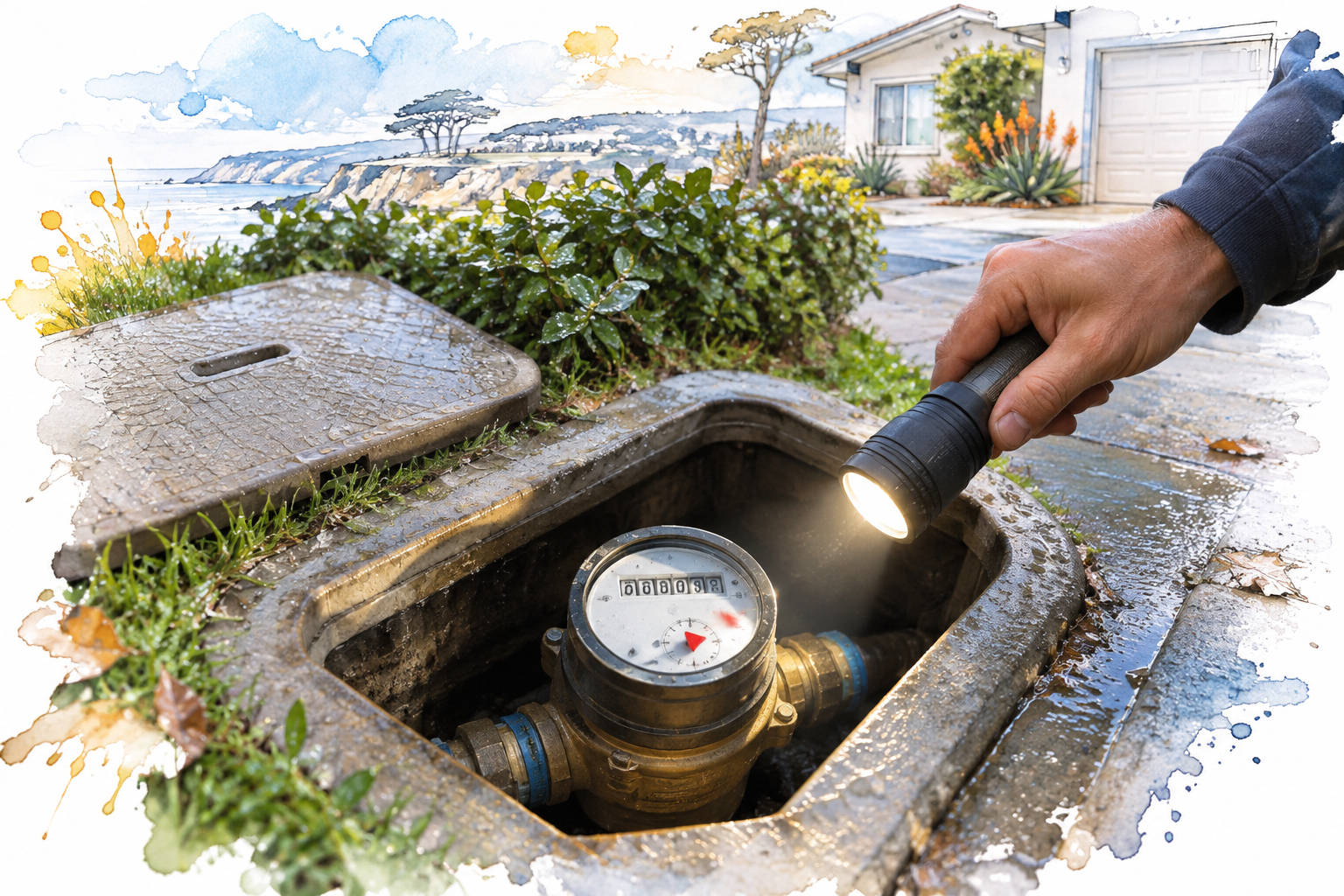
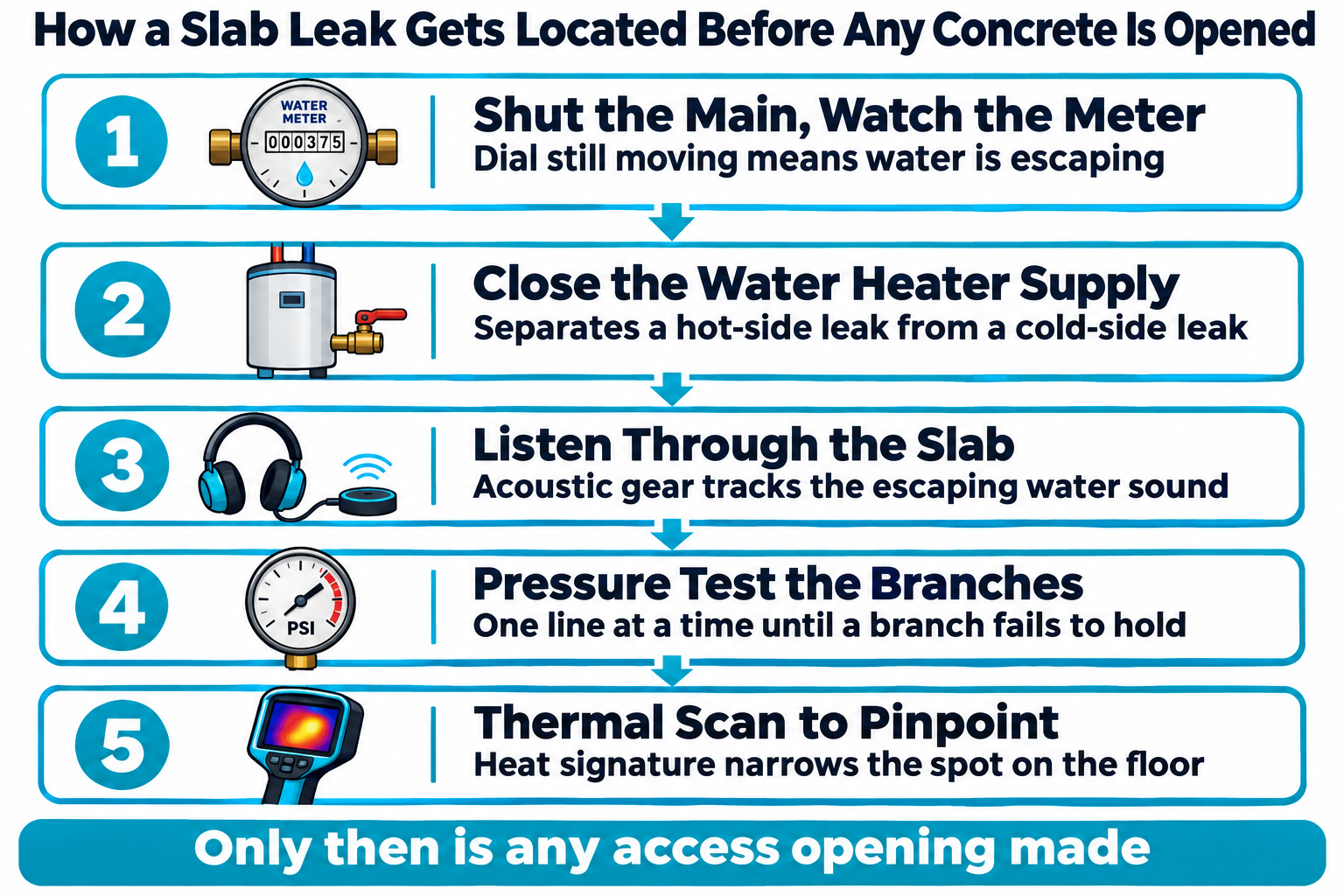
Step one: isolate the house at the meter. Shut off the main valve at the house, then watch the meter. If the low-flow dial still creeps, water is moving somewhere between the meter and that valve. We cover the basic version of this test in our post on warm floors, running water sounds and spiking bills, so I will keep it short here and spend the time on what comes next.
Step two: separate hot from cold. Closing the cold supply valve on top of the water heater takes the whole hot side out of play. If the sound or the meter movement changes, that narrows it to half the system immediately. Hot-side slab leaks are the more common ones I see in Santa Cruz County, partly because heat and our hard water are rough on copper over time.
Step three: narrow the location. This is where the equipment comes in:
- Acoustic listening gear, which hears pressurized water escaping through concrete and gets louder as you move toward it
- Line pressure testing, isolating one branch at a time and watching whether it holds
- Thermal imaging, which reads the heat signature a hot line leak leaves on the slab surface
By the end of that sequence we are usually talking about a small target area, not a room. If access work is needed, it is a defined opening in a known spot.
What Each Locating Step Actually Tells Us
Each test answers a different question. Here is how they stack up.
| Step | What it is looking for | What it rules out |
|---|---|---|
| Meter isolation test | Water moving with every fixture closed | Dripping fixtures and running toilets as the cause |
| Water heater supply shutoff | Whether the loss stops on the hot side | Half the system, hot or cold |
| Acoustic listening | The sound of pressurized water escaping | Large areas of slab with no signal |
| Line pressure test | A branch that will not hold pressure | Branches that hold, including ones recently repaired |
| Thermal imaging | A heat pattern on the slab surface | Cold-line suspicion when the pattern is clearly hot |
The Confirm-Before-You-Dig Sequence
This is the order we work in on a suspected slab leak, start to finish.
Finding It and Fixing It Are Two Separate Decisions
I want to be direct about this, because it is where homeowners get blindsided. The locate is one decision. The repair is a second decision, and it depends on what the locate finds.
One failure in otherwise sound copper is a very different situation than a third leak in the same slab in two years. The questions that decide the path:
- Pipe material. Copper, galvanized steel, or something else. One homeowner here had galvanized under a poured slab burst with the water already shut off at the house, and what they needed was not a patch.
- Age and condition of the rest of the system. If the whole run is at the same point in its life, fixing one spot buys you a short window.
- Leak history. First one versus a pattern.
- Access. Whether that line can be rerouted above the slab or through a wall instead of under the floor.
That gives you three realistic paths: a targeted repair at the located spot, a reroute of that single line, or a partial or whole-home repipe. If another plumber already told you repiping would be needed eventually, bring that up at the start. It changes which option makes sense.
And if you have had a repair in this same area that did not hold, say so. That is worth a second look at the previous fix before anyone commits to a plan.
If Insurance Is Involved, Say So on the First Call
Your policy may care about this more than you do. Water damage and freezing made up about 22.6 percent of all homeowners insurance claims from 2019 through 2023, second only to wind and hail, and most of it starts inside the building rather than from weather, according to industry claim data compiled by the Insurance Information Institute.
Carriers in California have also been pushing homeowners toward leak detection devices and automatic shutoff valves. I have taken calls from people whose insurer is requiring it, which is not a job they chose and not one they can decline. We cover what that install involves in our piece on insurer-required automatic water shutoff valves.
If you are in a claim or think you will be, tell the technician before the evaluation starts. Documented findings matter. Ask for dated photos, the location method used, and a written description of what was found and where. That paperwork is much harder to reconstruct after the concrete is patched.
One more local note: if your water agency flagged high usage, read the notice carefully. A leak on your side of the meter is your responsibility, and we explain that line in our post on what it means when the city says the leak is on your side.
What You Can Do This Week While You Decide
You are not in crisis. You are trying not to make an expensive mistake. These are worth doing in the next few days:
- Find your main shutoff and test that it turns. Many Santa Cruz County homes from the 1950s and 60s have a valve nobody has touched in decades.
- Read the meter at night and again in the morning with everything off, and write both numbers down.
- Photograph the warm spot, the stain, or the buckled flooring with the date.
- Note whether the running sound changes when you close the valve on top of the water heater.
Two things I would not do. Do not cut concrete to look, because you can open the floor three feet from the actual leak. And do not wait to see if it stops on its own. When a slab leak goes quiet, it usually means the water found an easier path, not that it stopped.
Frequently Asked Questions About Slab Leaks
I think I have a slab leak under my house in Santa Cruz. Who can find and fix it?
A licensed plumbing contractor that does both leak detection and slab repair, so you are not handing the job to a second company halfway through. Maverick Plumbing (CSLB #1102966) locates slab leaks in Santa Cruz County and parts of Monterey County using meter isolation, hot-side testing, acoustic listening equipment and thermal imaging, then handles the repair, reroute, or repipe based on what the locate shows. Active emergencies get 24/7 response; planned evaluations are scheduled, so call (831) 515-9903 to ask about current availability.
Will you have to break up my floor to find it?
No. Locating is done on top of the intact slab. Any opening comes after the leak is narrowed to a small area, and in some cases the line gets rerouted instead, which means no concrete work at all.
How long does the leak detection part take?
Plan on a few hours for a thorough evaluation. Each test eliminates part of the system, and rushing that is how people end up opening the wrong spot.
Can I just patch the one leak instead of repiping?
Often, yes. A single failure in sound copper is usually a targeted repair. But if the line is galvanized, or this is the second or third leak in the same slab, a reroute or repipe is frequently the better use of your money. That call gets made after the locate, not before.
What does a slab leak repair cost?
It depends on the pipe material, how many lines are affected, access, and whether the fix is a spot repair or a reroute, so I will not throw a number at you over the internet. Call (831) 515-9903 and we will talk through your specific situation.
Wondering Whether That Warm Spot Is Actually a Slab Leak?
We handle leak detection and slab leak repair for homes across Santa Cruz County and parts of Monterey County, CA, with emergency service available around the clock. If you want someone to confirm what is happening before any concrete gets touched, give us a call at (831) 515-9903 or send the details through maverickplumbingtechnicians.com and we will let you know what the schedule looks like.
